
Your CRM Data Is Probably Too Dirty for AI
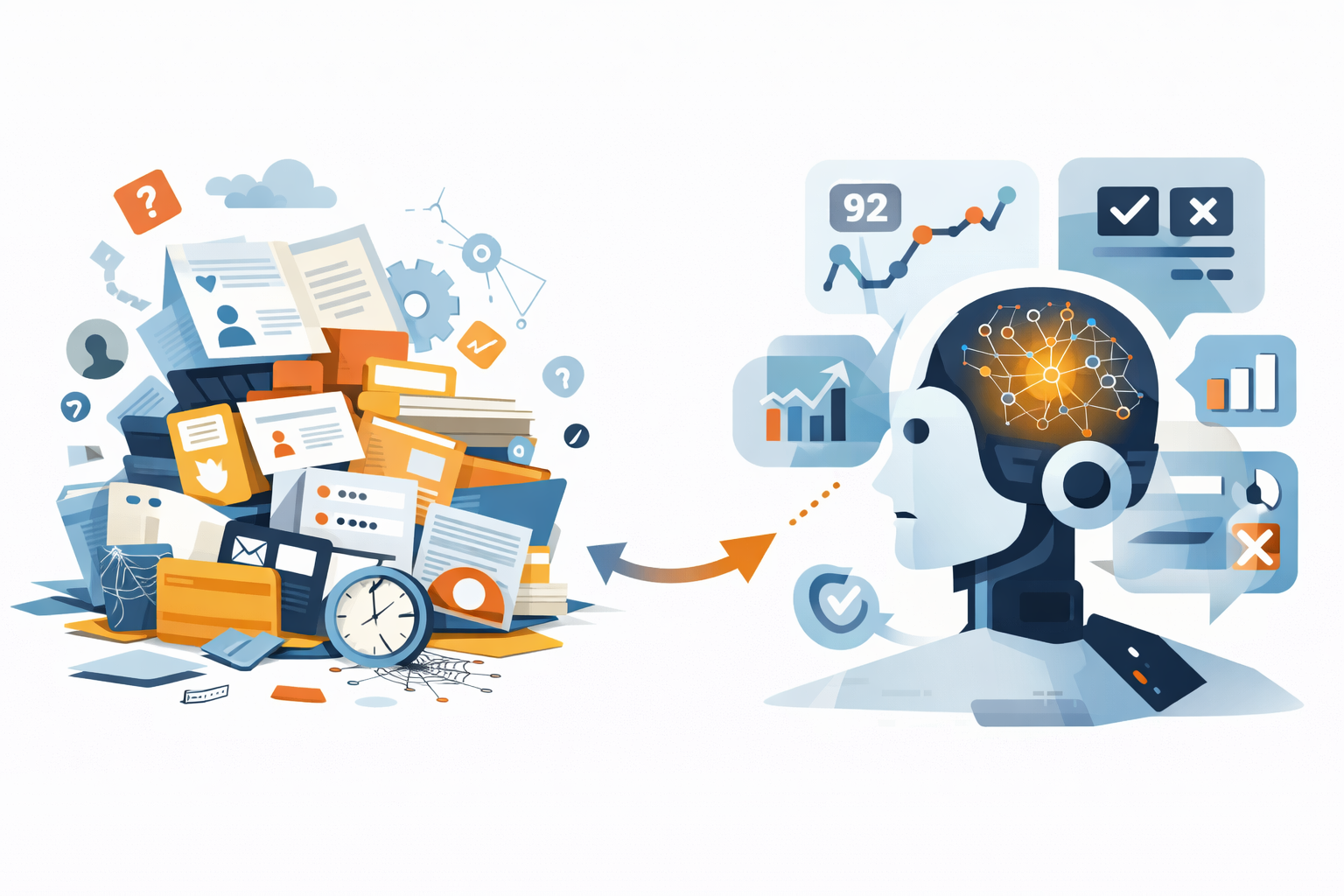
AI doesn't fix your data problems. It scales them.
The Sales Pitch vs. the Spreadsheet
Every Salesforce keynote, every vendor pitch deck, every LinkedIn thought leader is saying the same thing right now: AI is going to transform your CRM. Predictive lead scoring. Automated opportunity summaries. Intelligent forecasting. It sounds incredible — and in the demos, it is.
Here's the thing: those demos run on perfect data.
Your org doesn't have perfect data. Your org has three records for the same company — one with a typo, one from a 2019 import, and one a sales rep created last Tuesday because they couldn't find the other two. Your org has a "Notes" field doing the job of six structured fields. Your org has picklist values that stopped matching reality two reorgs ago.
AI features don't work despite your data. They work on your data. And when the foundation is messy, the outputs aren't just unhelpful — they're convincingly wrong.
The Five Ways Your Data Is Lying to You
Most CRM data quality problems fall into a handful of patterns. You probably recognize more than one.
Duplicate records everywhere. This is the classic. Multiple accounts for the same company, multiple contacts for the same person, sometimes across different ownership. Every duplicate fragments the picture. AI that tries to score or summarize an account is working with half the story — or two conflicting half-stories.
Picklists that lost their meaning. Somewhere along the way, someone added "Other" to every picklist. Or the industry categories were mapped to a taxonomy that no longer matches how the business thinks about its segments. Or "Stage" means something different to every team that uses the pipeline. When AI tries to segment or predict based on these fields, it's pattern-matching on noise.
Free text where structured data should live. The "Description" field is doing heroic, terrible work in most orgs. It holds product names, competitor mentions, deal context, objection notes, and sometimes entire email threads — all in unstructured prose. AI can try to parse this, but it's guessing. And it's guessing differently every time.
Missing relationships and hierarchies. Accounts exist as flat, disconnected records when in reality they're subsidiaries, divisions, or partner networks. Contacts aren't linked to the right accounts — or to each other. Without these relationships, AI can't reason about account families, buying centers, or influence maps. It sees isolated dots where it needs a graph.
Stale records nobody owns. The accounts that haven't been touched in eighteen months. The contacts with bounced emails. The opportunities sitting in "Negotiation" since last fiscal year. This dead weight doesn't just clutter reports — it actively misleads any model trained on the dataset. AI doesn't know the record is stale. It just sees a data point.
Why AI Makes Dirty Data Worse, Not Better
There's a tempting belief that AI will somehow clean things up — that the intelligence layer will see through the mess. It won't. It does the opposite.
AI models are pattern machines. Feed them duplicates, and they'll find patterns in the duplication. Feed them inconsistent picklists, and they'll build predictions on the inconsistency. Feed them free-text chaos, and they'll extract structure that doesn't exist. The output looks authoritative. It comes with confidence scores and neat summaries. That's what makes it dangerous.
Think of it this way: a bad spreadsheet just sits there being wrong. A bad AI feature actively distributes wrong answers to people who trust them.
Predictive lead scoring built on fragmented account data will systematically misjudge your pipeline. Opportunity summaries generated from junk "Notes" fields will sound plausible while missing the point. Forecasting models trained on stale, un-closed opportunities will learn that deals stay in "Negotiation" forever — and plan accordingly.
The failure mode isn't that AI doesn't work. It's that it works exactly as designed, on data that doesn't deserve that level of confidence.
A Readiness Gut Check
Before you flip on any AI feature, ask five questions. Not as a formal audit — just as an honest conversation with your team.
Can you find a single customer across all their records? If your duplicate rate is high or your merge rules are nonexistent, you don't have a customer view. You have fragments. AI needs a unified record to reason about.
Do your picklist values still mean what they meant when they were created? Pull up your Stage, Industry, and Source fields. If the values include "Other - See Notes," or if half your team uses a different value for the same thing, you have a classification problem masquerading as a data entry problem.
What's living in your free-text fields that should be structured? Open fifty random opportunity descriptions. If you can spot product names, competitor names, or deal sizes buried in prose, that's structured data that never got a proper home. AI will try to extract it. It'll get some of it wrong.
Are your account relationships mapped? Pick your top ten accounts. Can you see their subsidiaries, parent companies, and partner connections in the system? If those relationships live in someone's head or a spreadsheet taped to the side of the CRM, AI has no way to use them.
What percentage of your records are actually current? Run a report on records with no activity in the last twelve months. If it's a big number, your models are training on ghosts.
If you answered honestly and winced more than once, you're not ready for AI features. That's not a failure — that's useful information.
Getting Your Data AI-Ready
Knowing your data is dirty is step one. Cleaning it up is where most orgs stall — because the work feels unglamorous and the scope feels infinite. The trick is to not boil the ocean. Start with the data that your AI features will actually touch first, and work outward from there.
Start with deduplication. This is the single highest-leverage thing you can do. Merge your duplicate accounts and contacts before you do anything else. Use Salesforce's built-in matching rules as a starting point, but don't trust them blindly — review the results, especially for your top accounts. Set up duplicate rules to prevent new ones from forming. Perfect is the enemy of done here; getting from three records per company to one is worth more than agonizing over which phone number to keep.
Standardize your picklists. Audit every picklist field that AI features will use — Stage, Industry, Lead Source, and any custom fields feeding reports or scoring. Remove dead values. Merge synonyms. Kill "Other" wherever possible and replace it with real categories. Then document what each value means so the next person who configures a workflow doesn't have to guess.
Promote free text to structured fields. Look at what your team is actually typing into Description and Notes fields. If competitors, products, loss reasons, or deal sizes show up consistently, create dedicated fields for them. You don't have to backfill years of history — start capturing it cleanly going forward and clean up the recent stuff where it matters most.
Build your account hierarchies. Map parent-child relationships for at least your top accounts. This isn't just a data hygiene task — it fundamentally changes what AI can do for you. An opportunity summary that knows three deals are all within the same holding company is radically more useful than one that treats them as unrelated.
Set up a decay process. Assign someone — a person, a scheduled flow, something — to flag records that haven't had activity in a defined window. Archive or quarantine them so they stop polluting your active dataset. This isn't a one-time cleanup. It's a recurring discipline, and it matters more than any initial scrub because data rots continuously.
Make data quality visible. Build a dashboard that tracks your key hygiene metrics: duplicate rate, picklist adoption, records without activity, accounts missing hierarchy. Put it somewhere your team actually looks. What gets measured gets maintained — or at least, what's invisible definitely gets ignored.
None of this is exciting. None of it will make a conference keynote. But every one of these steps directly improves what AI can do with your CRM, because every one of them gives the model a cleaner, more honest picture of your business.
The Bottom Line
The organizations that will get real value from AI in Salesforce aren't the ones that activated the features fastest. They're the ones that did the boring, unglamorous data work first — deduplication, standardization, structure, relationships, hygiene.
Data quality isn't a box you check on the way to AI. It is the work. The AI features are just the payoff for having done it.
If your data isn't ready, that's not a reason to panic. It's a reason to start. Pick the dirtiest corner of your CRM, clean it up, and expand from there. The AI will still be there when your data can actually support it.
Related Articles
AI Is Not the Feature
Instead of marketing your product as “AI-powered,” focus on solving your customers’ core problems and delivering tangible improvements to their workflows. Prioritizing outcomes over technology will create a more durable and valuable product, as customers ultimately care about the results, not the underlying AI.
Prompt Engineering vs. Context Engineering: The Evolution of AI Interaction
As AI systems become more sophisticated, the focus is shifting from crafting perfect prompts to engineering comprehensive context that enables more natural and effective interactions.
AI Agents vs. Workflow Automation: Understanding the Fundamental Differences
While both AI agents and workflow automation can streamline processes, they operate on fundamentally different principles and serve distinct purposes in modern technology stacks.